BLOG
Insights on 360° feedback and leadership development

Insights on 360° feedback and leadership development
Alright, 360 Assessments do not fall into the testing category that you can “Ace”, however there are steps you can take to ensure that you are getting the most out of your 360 Assessment. Here’s one question to get you started:
Which of the following will help you get the most out of a 360 feedback program?
Acknowledge the Process – Feedback is a positive thing and should be used as a development tool. If you go into a 360 assessment with this in mind, you will get out of it what you put into it, which should be a clear and concise view of your strengths and weaknesses within your organizational culture. Feedback will tell a story, not fiction, and it’s up to you to listen to it. But awareness is only the first step.
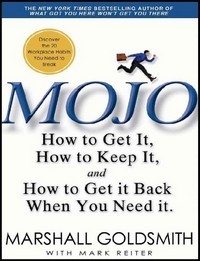
by Marshall Goldsmith. New York: Hyperion. 184 pages.
Reviewed by Diane Byington, Ph.D.
Are you burned out at work? Or, have you lost some enthusiasm and wish you could get it back? If so, check out this book. Marshall Goldsmith brings his long experience as an executive coach to the concept he describes as Mojo: that positive spirit toward what we are doing now that starts from the inside and radiates to the outside. In other words, we've got to feel enthusiastic toward what we are doing before we can send enthusiasm out for others to see. This book details how to increase your Mojo.
The most useful part of the book, for me, was his scorecard for measuring your Mojo. Goldsmith says we need to bring five qualities to an activity in order to do it well. These are: motivation, knowledge, ability, confidence, and authenticity. Likewise, five benefits we may receive from an activity include: happiness, reward, meaning, learning, and gratitude.
By Scott Belsky, Making Ideas Happen. (2010). New York: Penguin. 231 pages.
Reviewed by Diane Byington, Ph.D.
This book might be for you if:
You have lots of ideas but have trouble getting them to actually happen
You tend to be disorganized and need help organizing your projects
You are excited and full of energy at the beginning of a project but get bored and distracted as time goes by, or you love starting projects but rarely complete them
Your job is to manage creative professionals
Scott Belsky, CEO and Founder of the online creative network, Behance, has spent his professional life working with creative people and helping them to make their ideas "happen." His thesis is that great ideas abound, but getting them to completion is extraordinarily difficult and requires a different skill set than what is used to generate the idea. This book presents his ideas for what it takes to actualize an idea.
In most relationships, people want to have trust—with a romantic partner, with a family member, with a doctor or a dentist, with a mechanic or a plumber. In those relationships, without trust as a foundation, much can fail. Shouldn't we see it the same in the workplace? After all, a company’s success is based on trust—consumers must trust the brand, and employees, who, in essence, sell trust to consumers, most definitely need to trust their leaders. CommuniCon, Inc., says that “high-trust organizations have increased value, accelerated growth, enhanced innovation…and improved collaboration.” So why is it that, according to the 2013 Edelman Trust Barometer, 82% of people don’t trust business leaders to tell the truth? If you’re a leader in your company, that statistic should be alarming.
Luckily, it’s never too late to start building, earning, and increasing trust, and one basic building block is communication. Note that word well, though, because too often, leaders confuse the skill—communication—with its vehicles—communications. Gaining trust is not about which channels you use. It’s about the messaging—and the truth behind it—itself.
Written by Mary Schaefer – President, Artemis Path, Inc.
You can make sure your people are using their natural strengths. You can focus on job fit and culture fit. Is that all there is to ensure motivated employees?
When I think of supporting employee motivation, my thoughts go a slightly different direction. What if you demonstrate that their contributions make a difference? You can do this through empathy. Yes, empathy.
If you want to cultivate motivation, don’t do this.
There are those times when employees are put in the position of dealing with disappointment or being denied an opportunity to contribute. Management calls a project to a halt. A budget cut sends employees’ current job assignments into a spin, perhaps impacting the trajectory of their careers. This gnaws at people. I don’t often see attention given to addressing the meaning employees assign to such changes. They end up feeling bad because of what it means to them. They are expected to roll with the punches. After all, “It’s just business.”
Like him or hate him, you’ve got to hand it to Mark Zuckerberg—there’s no denying that, at a mere 30 years old, he’s a multibillion-dollar success. His baby—the social-networking site Facebook—recently posted shares worth nearly $75, almost double its May 2012 IPO price of $38 per share. Which means that, not only did he have a solid, viable idea in social networking, he also has had some success at company leadership. And we all—millennial and office veteran alike—could learn a thing or two from his style.
To start, Zuckerberg shows us that, to be a good leader, you first need to be true to yourself and have passion. Continually in the pursuit of the next cool thing, Zuckerberg proves he believes in his goals and is passionate about what innovation can do for his product. And it’s worked. As the old adage says, you can’t sell what you don’t believe in, and Facebook’s creator believes in the product, which cultivates in his employees the unwavering confidence and support that leads to success. And all of that is reflected in the fact that the company’s mission, “to give people the power to share and make the world more open and connected,” is the same today as it was ten years ago, at Facebook’s inception.
Many people agree: a workplace culture of fear limits employee engagement, productivity, and retention—and by turns, the bottom line. But often, leaders aren't cognizant that they've created that environment. However, Gallup surmises that lost productivity due to lack of employee engagement costs U.S. companies $300 billion annually. Other studies show that happier—and therefore more engaged—employees are more likely to be more “creative, productive, and committed.” In other words, good leadership doesn't have to be with an iron fist—in fact, more often, it shouldn't include iron or fists at all.
One way for leaders to ensure that they aren't creating a culture of fear is to consciously do the exact opposite—create a culture of happiness and fun. Which can be daunting; after all, to some leaders, “fun” might seem frivolous, and other leaders might see “happiness” as the employee’s responsibility. However, just a few changes to the environment can make all the difference to an employee’s productivity.
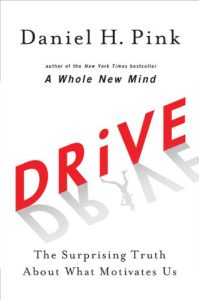
Daniel Pink, following up on his bestseller A Whole New Mind, picks up on another social trend that is growing in importance - a new way of motivating people. Here is his "cocktail party summary" of the book:
"When it comes to motivation, there's a gap between what science knows and what business does. Our current business operating system - which is built around external, carrot-and-stick motivators - doesn't work and often does harm. We need an upgrade. And the science shows the way. This new approach has three essential elements: (1) Autonomy - the desire to direct our own lives; (2) Mastery - the urge to get better and better at something that matters; and (3) Purpose - the yearning to do what we do in the service of something larger than ourselves."
In summertime especially, it’s easy to let the lure of everything outside the office (blue skies, birdsong, vacation plans) distract you from being productive in the office. Luckily, summer is also the best time to start taking steps to develop new habits that can last throughout the rest of the year.
To bolster productivity, try these tips:
Get up earlier. Giving yourself even just an extra 15 minutes in the morning can make a huge difference to how the rest of the day plays out. It might allow you to fit in a balanced breakfast, leave home without being in a stressed-out rush, and get to the office in time to set an attack plan for the tasks of the day. If getting up early scares you a little, try small increments at first, like five minutes earlier per week until you've gotten to 15—or more. Starting this habit in the summer is easier because of the amount of sunlight in the mornings; by the time winter (with its dark mornings) hits, you’ll already be acclimated to your get-up-earlier routine.
Thanks to the ongoing Values campaign from Foundation for a Better Life, folks across the nation have been supplied with tidbits from the lives of the famous and the not so famous—snippets that, through inspirational messaging, provide motivation to dream, to do, and to hope for what might seem like an impossible success. The billboards, TV commercials, radio spots, and videos remind us of the historic trials—and, in fact, the failures—of arguably rather successful people. Like Abraham Lincoln, whose story was riddled with personal pain, sacrifice, ups, and downs before he achieved the ultimate success of becoming the 16th President of the United States. Or Thomas Edison, who purportedly failed thousands of times before he created a successful light bulb.
In both cases, these men could have done what many human beings do: they could have shied from the risk of trying again. They could have taken the safe route, the well-traveled path, the life of complacency. Instead, both men continuously took both personal and professional risks to keep doing what they believed in. And, ultimately, through all of the risks, they were both remarkably successful. Had either been content to remain in his comfort zone, imagine what might be different for our country or our lifestyles today. Should it be any different for corporations?