BLOG
Insights on 360° feedback and leadership development

Insights on 360° feedback and leadership development
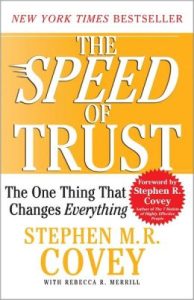
Don't mistake this Covey with his father, author of the "7 Habits" series. He is his own person, and has written a book that could revolutionize our view of trust in organizations. I highly recommend this book; it is deep and thorough and not to be read in a few evenings. The information and wisdom it possesses should be savored, pondered, and integrated slowly for the greatest impact. When corporate scandals, terrorist threats, and betrayal by our leaders have created low trust on nearly every front, Covey maintains that the ability to establish, grow, extend, and restore trust with all stakeholders is the key leadership competency of the new global economy.
Trust is defined as having confidence. When you trust people, you have confidence in them - in their integrity and their abilities. When you distrust people, you are suspicious of them. Covey cites a study showing that total return to shareholders in high-trust organizations is almost three times higher than the return in low-trust organizations. On a personal level, high-trust individuals are more likely to be promoted, make more money, receive the best opportunities, and have more fulfilling and joyful relationships.

Dr. Goldsmith is one of corporate America's preeminent executive coaches. He charges a lot for his services, and his clients enthusiastically assert that he's worth it. But if you don't have the money to hire him personally, you will get a flavor for his work by reading this fine book. And you might see yourself in its pages.
This book is designed to help successful people become even more successful by identifying an interpersonal problem that they need to stop. Goldsmith discusses the twenty habits that often cause successful people problems. These include: winning too much (the behavior that encompasses many of the other problems), adding too much value, making destructive comments, speaking when angry, withholding information, and not listening.
Goldsmith's solution to these interpersonal career stoppers is to understand what you need to change and then move through his formula for making lasting change. The most daunting step is deciding what needs to change. Goldsmith warns us not to undertake changing more than one item on the list at a time. To help you choose, Goldsmith strongly recommends getting feedback from those who see you regularly.
So, you've discovered that your business needs a change -- and that change is how your employees work. You've decided that they need to be more engaged, more motivated and that your leadership style has to change, but something just isn't working. Your employees are resisting, almost on the urge of revolting, but why? I'll tell you -- they don't know why they have to change. Change without reason, is as good as no change at all. All the tips in the world for how to engage your employees just won't matter if you can't implement them correctly. Here are a few steps that you can utilize to initiate change.
It’s no secret - Happy workers have a tremendous impact on productivity and keeping down costs. For many workers, flexibility is a key to maintaining a positive environment. Research shows that employees feel important when management makes it easier for them to work around their personal schedules. Not only does this increase demand for flexibility in scheduling, but it also suggests that companies should reevaluate where and how work is completed and their control over how employees spend their time.
According to a Gallop Poll, over $350 billion are lost each year due to satisfaction problems in the workplace. Changing management techniques and adopting the best practices can help your staff feel their jobs are truly a benefit to their lives.
Too often, managers get stuck acting like parents around a business. They spend more time trying to keep track of employees than focusing on their own work. Some scream commands then slam the doors to their office closed, leaving staff feeling resentful and often confused over the best ways to do their jobs. Others spread themselves too thin trying to do all the work in an attempt to meet company goals without making any enemies. A manager's role is a delicate balance.
If you're like most executives, you probably start your day fresh and energetic and end it tired and stressed but this isn't how it has to be. Despite the challenges, having an executive position is rewarding and praise-worthy, and it is possible to feel highly productive and satisfied when your day comes to an end. The key to achieving this lies in improving your time management. If you're finding it hard to mow through your daily tasks, here are a few steps to follow in order to get started.
Step 1 - Minimize Distractions
Before you get started with any of your daily tasks, minimize your distractions. This means switching off your cell phone, closing your personal emails and letting your voicemail service pick up your calls. Another great way to make sure you won't be disturbed (unless there's an emergency of course) is to make sure your staff knows what they're doing. Having a well-trained staff means fewer distractions for you each day.
Coaching has hit the mainstream. It’s showing up in Dilbert cartoons, sitcoms, and well, even the Kardashians are using coaches. Being mainstream simply means that there are a lot more choices one has when considering coaching. It is no longer the secret weapon for C level executives. And it’s not about correcting performance. It’s about motivation, behavior change and ultimately ensuring that people are having the conversations that matter most. I’m a business coach. Fully trained and certified, and hard at work helping leaders develop and grow for the last 15 years. I have seen coaching at work in organizations, making a profound difference in how leaders lead, and how individual contributors put their best effort forward.
Business managers could take queues from the sporting world, (perhaps forgoing the Gatorade showers after the big meeting) but like their coaching counterparts the more successful managers realize that they're not just managing groups of people, but rather coaching people that make up dynamic and effective teams.
The world's best sports coaches develop each team member to reach their full potential, while simultaneously pushing the entire team to success. Likewise, good business managers realize managing or coaching 'through their teams' can help their own teams to be more successful.
Effective coaches observe and understand the social dynamics of their teams, as well as the individual skills & strengths of each of the team members, and then guide these strengths and social bonds to come together with shared goals and purposes. This elevates a team's engagement & performance, as well as its company's bottom line.
The key to growing your company is to change with your industry -- and change doesn't always come easy. On paper, it's easy to construct a plan and execute it, but persuading your employees to go along with these changes may be difficult. Offering a pat on the back or a certificate are great catalysts for change, but they simply aren't enough. People need to know why the change is necessary, why it's important that they contribute to the change and what they will inherit from changing. Providing incentives that provoke these changes, will benefit not only your company, but your employees as well. Here are 5 incentives that provoke change.
No one exists in a vacuum, especially not in the business world. The rise up to a management position requires networking, mentoring, and coworkers helping along the way. When you reach upper management, you need a mentor on your side even more. You're dealing with pressure and situations that you don't encounter before you reach this level in the corporation, so getting a mentor who has years of experience in this environment is essential. Take your time choosing a mentor, however. You want someone you can easily communicate with, who is a natural teacher, and who can take your input, suggestions, and preferences into consideration for your mentorship. Once you've found the perfect mentor, you need to know how to apply their tips to improve your leadership abilities.