Contact Us
A valid email is required in order to receive the samples.
A valid email is required in order to receive the samples.
A valid email is required in order to receive the samples.
SCANNER FREEMONT / Data Analyst
Freemont is responsible for the digital conversion of survey responses while adhering to strict quality standards set forth by its managers. Freemont began its career at TruScore in 1996 as a Data Analyst and quickly became pivotal to TruScore's success. As the years passed, Freemont has slowly matured into part-time Data Analyst while also holding many positions in the work environment including On The Floor, On The Empty Desk, and Hold The Door (AKA Hodor).
RON SACCHI / Master Coach
A former Operations Manager in the High Tech Industry, Ron Sacchi brings decades of leadership and management experience to the organizational development and the executive coaching arena. An energetic thought-leader with a track record of success in all areas of Human Capital development, he has consulted and coached managers in start-ups, joint-ventures, high tech, pharmaceuticals, and media. Because of his business acumen and creative approaches to behavioral change, he is respected in the HR community specifically for the ability to direct, motivate, influence and inspire leaders to improve performance.
Holding an MBA from Saint Mary’s College, Mr. Sacchi is also licensed in various management, leadership and psychological profiling tools.
PAUL CONNOLLY, PH.D. / Assessment Expert
Dr. Connolly’s major expertise includes organizational measurement strategies, survey design and questionnaire development, 360-degree feedback, leadership assessment and leadership development. He has extensive training and experience in psychometrics. He co-authored many 360-feedback surveys with Dr. Clark Wilson, one of the originators of the 360-feedback concept. He has also facilitated the development of surveys with well-known sports performance psychologist Dr. Jim Loehr who founded the Human Performance Institute. He has worked to create assessments with many thought leaders in the Human Resources field.
Dr. Connolly is the author or co-author of seven books and many articles. He is a licensed psychologist and member of the Association for Psychological Science and Society of Industrial and Organizational Psychology. He is a graduate of Holy Cross College and Fordham University, where he received his M.A. and Ph.D. in general psychology.
DR CHUCK MELTZER / Master Coach
Dr. Chuck Meltzer is a Master Coach and President of the SynTECGroup, an organizational development consulting firm. As an executive coach, he draws on his training at a doctoral level in psychology, direct senior management experience and management consulting with a wide cross section of industries. He has developed an extensive series of strategies to assist leaders in creating organizational wide and personal change. Dr. Meltzer has a decade of direct senior management experience and 20 years’ experience functioning within his consulting and coaching practice. His coaching approach is solution focused and time framed. Based on determined goals, a personally customized approach to the process has enabled his clients to realize sustainable change in a manner that allows them to enhance their effectiveness and success as leaders within their organization.
Dr. Meltzer is certified and a master trainer in several coaching assessment tools that he employs within his practice.
ERIN HIRSCHLAND / Master Coach
Erin is an organization development expert with nearly two decades experience serving organizations of all sizes across industries on a broad range of issues. Working with leadership teams, she helps articulate an actionable vision and corresponding values, connecting these to organizational strategy, execution and results. Her tools of choice include senior team retreats, one-on-one executive coaching and proven survey and related instruments.
Erin’s additional expertise includes designing employee selection systems, developing performance management tools that increase performance across the organization over time and employee and customer experience metrics. An effective facilitator and coach, Erin works with leaders and their teams to build trust, commitment and results.
She holds a Bachelor of Arts degree in Psychology from the University of California, Santa Barbara and a Master of Arts degree in Industrial/Organizational Psychology from the University of Colorado.
SONYA D HAMILTON / Senior Assessment Consultant
Sonya is a Senior Assessment Consultant at TruScore with over 24 years of experience designing and delivering 360 feedback solutions and providing 360-based coaching, training and interpretation.
Sonya has extensive experience working with Managers and Leaders, guiding them through the feedback and development journey and providing insights and direction to help maximize their impact within the organization. Sonya’s areas of expertise include 360-based coaching, 360 data analysis and interpretation, Train-the-Trainer certifications, facilitation, survey & questionnaire design, and the design and delivery of assessment programs.
Sonya has a Bachelor’s degree in psychology and a Master’s of Science degree in Industrial & Organization Psychology from Springfield College with a specialty in Counseling and Psychological Services. She is a Master Trainer for TruScore and the Clark Wilson Task Cycle surveys receiving a Certificate of Achievement in “How to Train a Trainer”. In addition, Sonya is certified to administer a variety of other psychometric instruments including employee engagement and organizational instruments as well as the line of Hogan Personality Assessments.
KAYLEY MOTZ / Assessment Advisor
Kayley draws on her extensive customer service background to provide clients with prompt, quality support. In her role as Assessment Advisor, Kayley works to ensure clients’ needs are being met. She assists in project set up and management, as well as processing and quality checking feedback reports. Kayley also aids in the execution of the day-to-day responsibilities of the production team, such as coaching session scheduling and tech support.
CRYSTAL HUGHES / Assessment Advisor
Crystal leverages her extensive background in Industrial-Organizational (I-O) psychology as she manages the day-to-day operational and tactical aspects of multiple and large scale projects for TruScore.
Crystal assists clients with setting up and managing feedback projects, and serves as the point of contact throughout the entire process. She quality checks feedback reports, and provides tech support when needed.
ELLIE SOLOMON / Assessment Advisor
Ellie manages project implementation for the entire 360 assessment feedback process and ensures that each client’s unique needs are met on time and in an efficient manner. Ellie consults with clients who use TruScore’s off-the-shelf Task Cycle® instruments as well as providing hosting solutions for clients using their own survey content, including custom processes and reports. She helps clients navigate through the TruScore® survey hosting software, having literally written the handbook that several clients are using.
She coordinates and implements all translation efforts, including soliciting bids, managing timelines, providing files to the translation companies, implementing translations for the web pages, and testing.
ULLA WESTERMANN / Software Engineer
Ulla uses her years of experience as a software engineer to maintain and add new features to TruScore's applications. She also helps with customizing feedback reports based on client needs.
HANK CURTIS / Business Development Manager
Hank manages and assists in the analyzing, planning, research, and development of TruScore’s objectives and strategic plans in order to achieve business opportunities, growth, and financial profitability.
Hank drives the expansion of TruScore’s direct sales, establishes relationships with TruScore’s clients, identifies clients, and keeps up-to-date on industry trends and client developments.
TAYLOR BRANTON / Bookkeeper
Taylor is responsible for managing payroll and employee fringe benefits programs, in addition to organizing company gatherings and outings. Taylor oversees day to day accounting needs as it relates to client invoicing, accounts payable, and general compliance requirements. She also has a hand in month, quarter, and year end reports and works closely with the CEO and CTO to furnish details necessary to make accurate business projections and decisions.
KURT BLAZEK / Design Director
Kurt uses a unique blend of strategic thinking with dynamic executions to create TruScore’s visual and interactive design. He is responsible for creating, evolving, and sustaining the company’s brand to internal and external stakeholders through multiple mediums. He oversees all of TruScore’s digital strategies, along with the implementation of social media tools and techniques.
Kurt leverages TruScore’s marketing and messaging information to identify, evaluate, and apply methods to maximize the effectiveness of the search campaigns across all of the major search engines. He tracks and measures the ROI of search engine rankings, direct print, and marketing websites.
JOSH SHEETS / Chief Operations Officer
Josh is responsible for all day-to-day aspects of managing the operations and various functional areas including business development, sales and marketing, client delivery, vendor relations, human resources, and IT.
Josh helps to ensure outstanding customer service, and the administration of long-term and day-to-day business processes that complement the delivery of high quality, innovative customer-focused survey tools, assessments and hosted survey offerings.
TOM KUHNE / Managing Partner and CTO
Tom joined TruScore in 1995 and has served in a number of roles, including Data Analyst, IS Manager, and VP & CIO. In his current role as Managing Partner and CTO, Tom is the driving force behind TruScore's technology vision for the present and the future. He manages all aspects of TruScore’s information systems, ensuring all systems meet the highest functionality and security standards.
Tom enjoys working hand in hand with clients and partners to make sure TruScore® delivers the technology and advancement that has become expected of it as a leader in the online assessment marketplace.
DEREK MURPHY / Chief Executive Officer
Derek joined TruScore in 1996 and has served in a number of roles, including Data Analyst, Operations Manager, and President & COO. In his current role as CEO, he is responsible for planning and implementing the strategic direction of the company. In addition, Derek is involved in product development and overseeing the day-to-day business operations for TruScore.
TruScore founder Dr. Daniel Booth, a pioneer in the field of assessment of leadership and management skills, served as a mentor to Derek for more than a decade. During this time, Derek became certified on TruScore’s full line of management and leadership assessments. He currently uses these skills to lead content debriefings with customers and partners on a regular basis.

Insights on 360° feedback and leadership development
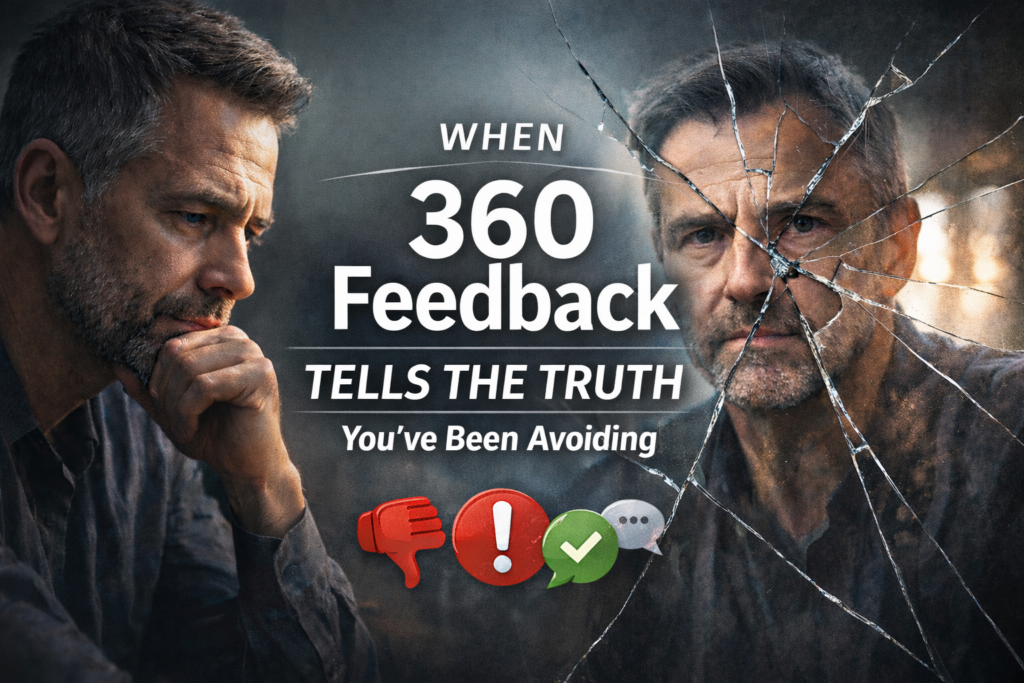
360 degree feedback has a unique way of surfacing patterns leaders may have rationalized, minimized, or simply never seen. When feedback aligns across peers, direct reports, and managers, it can reveal a truth that’s difficult to dismiss—and even harder to ignore.
This is where 360 feedback becomes powerful. And uncomfortable.
Unlike traditional performance reviews, 360 feedback doesn’t rely on a single perspective or moment in time. It aggregates perceptions from the people who experience a leader’s behavior day after day.
When multiple raters independently point to the same strengths—or the same gaps—it reduces ambiguity and removes plausible deniability.
In other words:
This is often the moment leaders realize the feedback isn’t about intent—it’s about impact.
Resistance is rarely about arrogance. More often, it stems from:
Without structured reflection and support, leaders may dismiss feedback as unfair, inaccurate, or politically motivated.
That’s why how feedback is delivered—and supported—matters as much as the data itself.
Honest 360 feedback only creates value when it leads to behavior change. Organizations that pair feedback with structured follow-up—such as coaching and development planning—see far stronger outcomes. (Related: Wrapped Up Your 360 Assessment—What’s Next?) At TruScore, effective development starts with three principles:
Feedback should surface the few patterns that matter most, not overwhelm leaders with noise. Research consistently shows that overly complex reports reduce engagement and follow-through. (Learn more: Why Do-It-Yourself 360s Fail)
Leaders need help interpreting why patterns exist before jumping to solutions.
Real change happens through follow-up, coaching, and continued feedback—not a one-time report. This is why many organizations integrate 360 feedback into broader leadership development and coaching initiatives. (Explore: Unlocking the 360 Assessment Process)
When leaders feel supported rather than judged, they are far more likely to lean into the truth instead of resisting it.
The most valuable insight in a 360 report is often the one a leader least wants to see.
Handled well, that insight becomes a turning point:
Handled poorly, it becomes another ignored document.
360 feedback doesn’t force change—but it creates a mirror that’s hard to look away from.
This e-book uncovers the thinking, tools, resources, and guidance that can help organizations get more results from their managers while spending less of their L&D budgets.
What makes 360 feedback more credible than manager-only reviews?
360 feedback combines multiple perspectives, reducing individual bias and highlighting consistent behavior patterns.
How should leaders respond to negative 360 feedback?
Start with curiosity. Look for themes, seek clarification through coaching, and focus on small, observable behavior changes.
Can 360 feedback damage confidence?
Poorly delivered feedback can. Well-designed and well-supported 360 feedback builds self-awareness and long-term confidence.
The leadership themes surfaced in 360 feedback are consistently supported by research and large-scale assessment data:
These findings reinforce why consistent patterns across rater groups are so difficult—and so important—for leaders to ignore.
The truth revealed in 360 feedback is rarely new. It’s usually familiar—but finally undeniable.
That moment of recognition is where leadership growth begins.