BLOG
Insights on 360° feedback and leadership development

BLOG
Insights on 360° feedback and leadership development
A leader opens a 360 report in March and picks two behaviors to work on. By May, the report is a bookmark. By September, a colleague might ask how it’s going, and the honest answer is “I think better?”
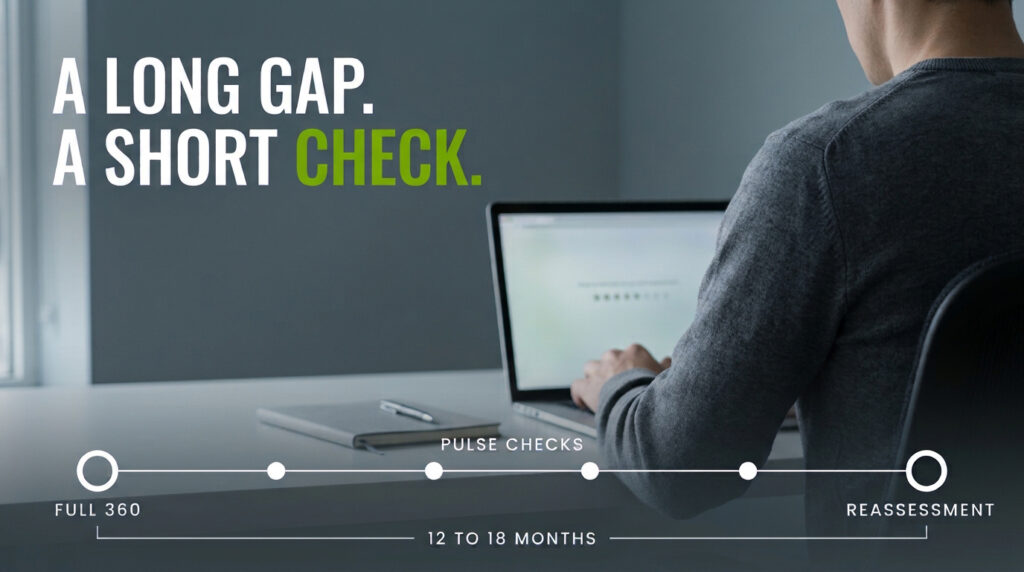
Our published guidance on reassessment suggests following up every 12 to 18 months. The Center for Creative Leadership’s Jean Leslie writes that participants should be held accountable for their progress “every few months.” Those two timelines leave a stretch with no data at all. A 360 feedback pulse check is one way to fill it.
Here is how we think about designing one.
A full reassessment answers a big question: how does this leader’s behavior look across the whole competency set now? It is worth running, and it takes planning, rater time, and a debrief.
A pulse check asks a smaller question: are the one to three behaviors this leader committed to showing up differently? Our assessments page describes Pulse Check assessments as “quick and targeted 360 degree assessments to monitor progress and drive continuous improvement.” The word to notice is targeted.
The research gives two reasons to want one. Leslie’s review cites Goldsmith and Underhill (2001), who found a relationship between how often managers followed up and the positive change others perceived. That is a correlation, not proof that more check-ins cause more change, but it points in the same direction as the “every few months” advice.
The second reason is what happens after the report. In their 2005 review in Personnel Psychology, Smither, London, and Reilly describe a 2000 study by Atwater and colleagues in which reactions to upward feedback, including using it to set improvement goals, were positively related to improvement afterward. They also cite a study that followed 252 managers through five annual rounds of an upward feedback program: managers who met with their direct reports to discuss the feedback improved more than other managers. The review doesn’t present that as a controlled experiment, so read it as a pattern, not proof. Together with the Goldsmith and Underhill finding, it suggests the follow-through after a 360 is worth supporting, and a pulse check gives that follow-through a regular checkpoint.
A pulse check is easy to launch and easy to get wrong. These three rules keep it useful.
1. Same Raters. Send the check to the people who rated the original report, or the subset still working closely with the leader. A new rater pool changes the measurement, so any movement could come from who is answering rather than what changed. If someone has left the team or changed roles, note it and keep going. This is a guideline from basic measurement logic, not a rule from a specific study, so treat it as a design default. Our guide to rater selection covers who qualifies.
2. Same Behaviors. Ask only about the items tied to the goals the leader chose. Raters need real line of sight to a behavior to rate it, and the same logic applies to question scope. Ten items on behaviors nobody has been working on collect ten answers the leader can’t use. Two or three targeted items give raters something specific to look for and give the leader something specific to act on.
3. Said Out Loud. Tell raters, and tell the leader, what the pulse check is. It is a progress read on named goals, not a second verdict, and not a scorecard for the file. Being open about that is the same transparency we recommend for avoiding the “Big Brother” problem in 360 feedback. A pulse check can work as a visible reminder of the goal, and it only does that job if people trust it is for development.
This is a hypothetical, not a client story. Imagine a director whose report showed that her team wanted more clarity on priorities. She chose one goal: end each Monday meeting with the three priorities for the week. Three months later, her coach sends a pulse check to the same direct reports with two items on priority clarity.
The results can only say so much. If the ratings tick up, she has early evidence that people are noticing. If they don’t move, that is a prompt for a conversation with the team and her coach, not a conclusion. She might ask the raters directly what they would need to see. Either result beats waiting until the next full round to find out.
A pulse check also gives the leader a reason to go back to the team. Sharing the goal and asking for another read signals that the first report led somewhere. That conversation can matter as much as the number, and it is easy to schedule alongside the survey.
It can’t replace the full 360. It covers a few behaviors, so it says nothing about the rest of the competency set, including anything that may have slipped while the leader focused on two goals.
It can’t establish cause. A score that moved after a goal was set might have moved for other reasons, and a small group of raters amplifies noise. Treat a one-point shift on a handful of items as a conversation starter.
It can’t stand in for follow-up conversations. The first 30 days after a 360 are where the debrief and accountability habits get built. A pulse check only measures the work those habits produce.
We’re biased: TruScore offers Pulse Check assessments, so we think a short check-in between rounds is worth designing carefully. If you want to see how one fits alongside a full assessment and year-over-year trend views in the reports, our team can walk you through it.
Explore our 360 degree assessments, including Pulse Check.
We don’t have a research-backed number. Leslie’s advice to hold leaders accountable “every few months” is the closest anchor, so many programs would reasonably pick a point partway between the debrief and the full reassessment. Give leaders enough time to practice the new behavior before raters are asked about it. The Answer Center covers cadence in more detail.
That depends on group size. With a handful of raters, breaking results out can make individuals identifiable and can hurt candor. Set a minimum group size in advance and tell raters about it up front.
We would keep it out. It samples a few behaviors from a small group, and attaching stakes can change how raters answer. It works best as a development input.