BLOG
Insights on 360° feedback and leadership development

Insights on 360° feedback and leadership development
Has your bark lost its bite? Ship lost its rudder? Your charisma lost its oomph? Are you having difficulty getting your employees to see your vision and pursue it with the same energy you've put into it all these years?
Maybe your vision isn't the problem. Maybe it's time for a different kind of adjustment, a new leadership style. Changing your leadership style might be harder than changing the vision you set for your company or organization long ago, but it is well worth the effort, both for the growth of your company and your own personal growth. On the other hand, once you see how well different styles work in different situations, you may learn very quickly!
Are you a seasoned leader struggling to keep your team motivated? Perhaps you've recently been asked to step into a leadership role for the first time, but you're wondering whether you have what it takes. The beauty of leadership principles is their relevance at any stage of your development.
Wander the aisles of any bookstore and you're certain to find an entire section dedicated to leadership. Browse top-rated podcasts; leadership advice is not hard to find. So with so many available opinions on the subject of leadership, is there one concept that can revolutionize your ability to lead your team? Absolutely.
Everyone has heard the phrase, "do what you love and you will never work a day in your life." While this may be a great idea in theory, for most people it is not a reality. Furthermore, doing what you love can turn a once enjoyable hobby into work, which then has a negative impact on quality of life from two separate angles. In his book "The Manager's Dilemma"
Imagine a staff meeting that employees eagerly attend because they know the meeting will generate stimulating discussions. People will exchange ideas, support each other and build on each other’s suggestions. Everyone feels…
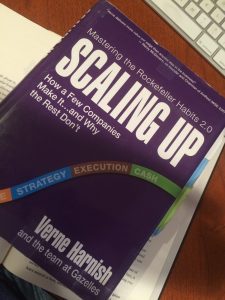
This is not one of those books you’ll read from cover to cover while sipping a cup of coffee with your feet up on your desk. It’s more of a textbook, or a workbook, for CEOs and their executive teams to work through issues involved in scaling up their businesses. The first chapter is an executive summary, and the author describes its fast pace and many lists as “drinking from a fire hose!” It’s intense, so keep both feet on the floor. The ideas in the rest of the book are served up in more bite-sized pieces, although it never really slows down.
Harnish describes the keys to scaling up as: attracting and keeping the right people; creating a truly differentiated strategy; driving flawless execution; and having plenty of cash to weather the storms. Accordingly, there are sections devoted to each of these topics. Each section has at least three chapters and numerous worksheets to be completed. I think, if you work your way through the book, you’ll be happy you did.
Unfortunately, leadership is not all about influence, perks, and big offices. There is a reason that leaders are paid the big bucks, and that is not simply to lunch on the corporate account and tell others what to do. Instead, leaders have significant responsibilities and are often accountable for substantial operational, technology, budget, and personnel decisions.
As you can imagine, these decisions aren’t typically easy. More likely, they are complicated and multi-faceted with both short and long term implications. Definitely not for the faint of heart. So how do strong leaders make tough decisions?
When your employees are stressed, it's impossible not to see it. They're shorter-tempered with one another, more likely to get sick or have health problems, and, as it turns out, are less productive. Stressed employees report that only about 9% of them are engaged at work, which means that the more stress you heap on your employees, the less they're going to perform for you. If you fear that your employees' performance is decreasing, make sure that you understand how stress can affect employee engagement.
Stress doesn’t have to be related to money. Certainly, the amount of money that they’re making can have a significant impact on employee stress. If they’re unable to pay their bills, they may find themselves wondering why it’s worth giving their all at their jobs at all!
How many famous leadership styles tout “Bring in the revenue!”…”Push your employees to the top!”…(and) “The heck with values–sales and growth are what counts!” One famous leadership style, which has–since its inception 8 years ago–definitely brought in new accounts, top revenue and an expanded reputation, places its greatest focus on “mission,” values and employee happiness. This famous leadership style belongs to Neil Grimmer, the founder of Plum Organics, the no-BPA, no-fructose, no-artificial ingredient, baby-food and child-snack maker with 150 products bursting with pure fruits and vegetables–and promoted by Wal-Mart and Target!
New leaders earn their promotion. They are successful, they have proved their value and now they must lead. Many new leaders, typically, make one of two primary errors:-
They lead from the middle, or
They just don't lead at all
Lead From the Middle
You've just been promoted, or you have come in from outside and are new to the team. You want to prove your worth - what you know, what you can do, how much experience you have. You must 'prove it' to the people who promoted you, and you must 'prove it' to your team. So, you roll up your sleeves and dive right in. You want to show you can do it faster, better, smarter, with fewer resources and still beat the deadline. The more you are at the coalface, the more you are showing everybody just how good you are.
Have you dreamed of inspiring others, but hesitation left you in the background while someone else took the limelight? Have you wanted to guide your co-workers, but weren’t sure how? Did you have creative ideas to better your company, but couldn’t find the right opportunity to present them? Within every one of us is the ability to become a leader, a great leader at that, even if you’ve been a follower your whole life. How do you go about accomplishing such a dream?
Let these five essential tips get you started: